

May 10-12, 2026
Key Insights from Peter Wright’s Keynote at the Board of Canadian Registered Safety Professionals (BCRSP) 50th Anniversary Conference
As organizations adopt increasingly sophisticated technologies to monitor, predict, and prevent workplace incidents, a new challenge is emerging across the occupational health and safety profession: How do we balance innovation with trust?
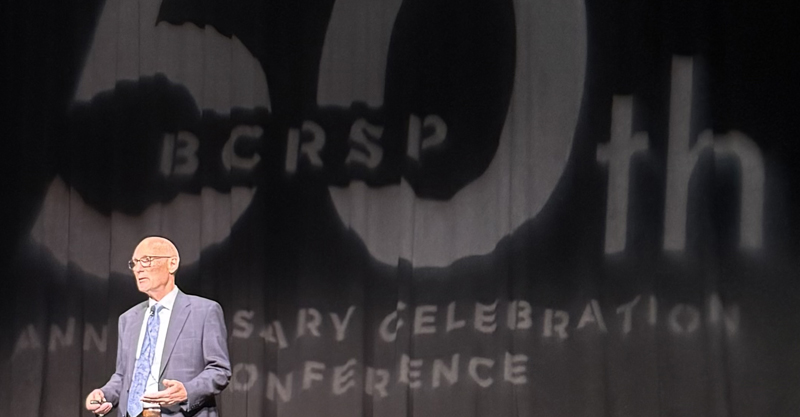
This question sat at the centre of Peter Wright’s keynote at the Board of Canadian Registered Safety Professionals (BCRSP) 50th Anniversary Conference. Exploring the rise of Safety 4.0, the session examined how artificial intelligence, predictive analytics, connected devices, and advanced monitoring technologies are reshaping workplace safety, often faster than organizations are prepared to govern them.
Throughout the session, live audience polling revealed a profession standing at a critical turning point. While many organizations are beginning to explore advanced safety technologies, most continue to rely on traditional measurement models and fragmented data systems.
A Profession Still Grounded in Reactive Safety Measurement
When attendees were asked what currently drives their organization’s OHS data strategy, 51% identified lagging indicators as their primary focus. Incident tracking and post-event reporting remain dominant across many workplaces. Another 45% reported using leading indicators such as proactive auditing and hazard identification, while only 5% indicated that predictive analytics currently shape their safety strategy.
The findings highlighted a significant gap between the growing conversation around Safety 4.0 and the operational reality inside many organizations.
Safety Technology Adoption Remains Uneven
Audience polling also revealed varying levels of technology adoption across the safety profession. Half of respondents reported using IoT or environmental sensors in some capacity. Adoption rates dropped considerably for more advanced technologies. Only 8% reported using wearable or biometric technologies, and another 8% indicated they are using computer vision or AI-based systems. Most notably, 34% of participants selected “none of the above.”
The results suggest that while the language of digital transformation has become commonplace in safety discussions, implementation remains inconsistent across organizations, sectors, and operational environments.
Data Fragmentation Continues to Limit Progress
One of the strongest themes to emerge from the session was the ongoing challenge of data architecture. While 49% of respondents reported having a unified “single source of truth” platform for safety data, 42% still rely on siloed systems, disconnected spreadsheets, or separate vendor portals. Another 9% indicated they continue to use primarily paper-based systems. Without integrated data environments, organizations face significant barriers to generating predictive insights, identifying patterns, and building proactive safety strategies.
The discussion reinforced an important reality for many organizations: collecting more data does not automatically create better decision-making.
Trust May Become the Defining Safety Metric of the Next Decade
As conversations shifted toward workforce monitoring, transparency and employee trust quickly emerged as defining themes. When asked how transparent organizations are about worker data collection practices, 59% of respondents described their approach as only partially transparent, often limited to legal or compliance requirements. Just 36% reported full transparency with workers about how their data is collected, used, and monitored.
The trust in data is a clear concern for this profession. Only 9% of respondents believed employees have a high level of trust in their organization’s handling of intimate health or behavioural data. Meanwhile, 41% reported low trust levels, pointing to growing concerns around surveillance, privacy, and organizational intent. The findings reinforced a key message from the keynote: technology adoption without workforce trust creates long-term organizational risk.
Ethical Boundaries Produced Strong Consensus
Some of the clearest audience responses emerged during discussions around ethical limits and organizational overreach. When participants were asked whether off-duty personal data, including social media activity or benefits information, should be incorporated into safety dashboards to help prevent serious incidents, 95% opposed the idea. Audience responses also revealed strong caution around the use of AI in employment-related decision-making.
More than half of respondents, 52%, rejected the idea of using AI models to identify “accident-prone” workers for hiring decisions. Another 35% supported the use of predictive models only after employment as part of a support-based intervention strategy, while 13% supported using predictive models to deny employment altogether.
The results reflected growing recognition that predictive capability does not eliminate the need for ethical judgement, governance, and proportionality.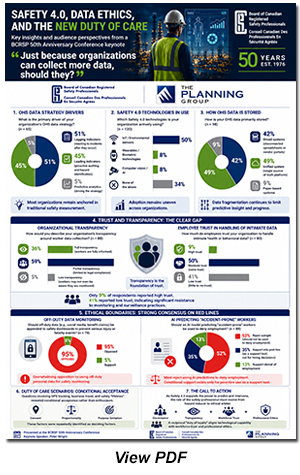
The Future of Safety Leadership
The keynote concluded with a broader reflection on how the role of safety professionals is evolving. As organizations gain greater ability to monitor behaviour, predict outcomes, and intervene earlier, expectations around ethical leadership are also increasing. Safety professionals are now being asked to navigate questions involving privacy, consent, transparency, governance, and organizational trust alongside traditional risk management responsibilities. Safety 4.0 is introducing powerful new tools into the workplace. The organizations that succeed will be those that pair technological capability with clear governance frameworks, transparent communication, and a strong commitment to workforce trust. The future of occupational health and safety will depend as much on ethical leadership as it does on innovation itself.
The Planning Group is a management consulting firm, dedicated to helping organizations achieve measurable benefits through the practical application of strategic and operational planning. Since 2002 we have provided business planning consulting expertise, strategic advice, and facilitation to clients in all sectors.
The Planning Group | Management Consulting Firms | Strategy Consulting