


October 19, 2026
The session opened with two retail classics. In 2002, Target's analysts combined loyalty-card, purchase, and demographic data to predict that a teenage customer was pregnant and mailed her baby-product coupons before she had told her family. In 2014, Canadian Tire, then Canada's second-largest Mastercard issuer, combined retail purchases with credit data and found that items such as a chrome license-plate frame or cheap potting soil predicted default risk more fairly than a credit score. Together the two stories show that appended data can reveal what no one agreed to share, and that the same data can also produce fairer outcomes.
Insurance has already made these trade-offs. Postal code, credit data, social media, satellite imagery, and driving telematics feed real-time, individualized premiums. Some insurers and benefit plans use predictive analytics to intervene during disability claims, and pharmacogenetics and wearable data are being explored to prevent chronic conditions.
The session then turned to a current example from the automotive world. A recent Tesla software release takes control of steering and braking when it judges a collision imminent, even in full manual mode, with no consent screen and no override prompt. That example framed a question the speakers returned to all afternoon: are safety professionals willing to let AI move from supporting a decision to making one?
OHS has its own success stories. Swire Coca-Cola reported a 27% decrease in lost day rates using computer-vision AI for real-time serious injury and fatality (SIF) prevention. Americold and Vertical Cold Storage reported 77% fewer injuries and 98% fewer near-misses from AI site-intelligence platforms running on existing cameras. JE Dunn Construction predicted 75% of recordable incidents on high-risk projects, which prompted more than 350 targeted safety conversations. These uses watch processes and environments, and they raise few ethical objections.
The newer examples draw on worker-specific data. The Total Mine Risk framework combines atmospheric variables with individual experience, shift duration, and training scores to predict risk patterns 70 to 76% accurately up to 48 hours ahead. Acoustic cohort pattern matching compares an individual's hearing tests against workers with similar age, tenure, and task profiles to predict hearing loss before it is clinically detectable. DHL's anonymous video analytics cut accidents by up to 40% using fully anonymized, GDPR-compliant computer vision that never identifies an individual worker.
The speakers argued that the technical constraints have fallen away. Most organizations already collect more data than they know how to use, computing capacity is no longer the bottleneck, and AI now makes sense of messy, disparate sources faster than most safety programs can govern it. What remains is professional judgment about what to do with all of it.
The session framed the choice with the cost-benefit line every OHS decision already sits on. At one end, spending nothing protects profit and productivity while accepting far more harm. At the other, spending half of revenue on OHS brings risk close to zero while halving productivity. Safety 4.0 leaves the trade-off in place and makes it faster, more granular, and more personal.
The obligation itself is unchanged. The BCRSP Code of Ethics states that the primary obligation of safety professionals in Canada is to protect the public interest and ensure that occupational activities are performed safely and effectively, without risk to people or the environment. The terrain around that obligation is moving from lagging indicators toward predictive and prescriptive analytics. Peter used a seatbelt analogy: society moved from seatbelts as a personal choice to a mandate because prevention was possible, and prediction raises the same question. A worker on an oil rig who could have predicted a blowout once faced consequences after the fact. If the prediction is now possible, the question is whether that worker should be obligated to stop it.
The first live poll showed where practice stands. Among PDC2026 respondents, 57.1% said lagging indicators drive their OHS data strategy, 28.6% said leading indicators, and 14.3% said predictive analytics. BCRSP's figures were 51%, 45%, and 5%.
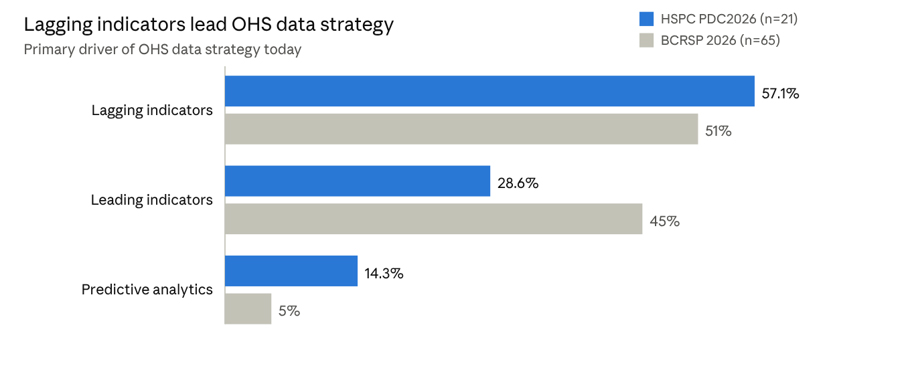
HSPC PDC2026 live poll, n=21 · BCRSP 2026 live poll, n=65
Two related polls pointed the same way. IoT and environmental sensors were the most common Safety 4.0 technology at 55.6% of selections in Regina (50% at BCRSP), with wearables and computer vision each at 3.7% (7% and 8% at BCRSP) and 37.0% choosing none of the above (35%). On data storage, 53.8% described a unified platform, 42.3% siloed spreadsheets or portals, and 3.8% paper (BCRSP: 49%, 42%, and 9%).
Three polls explored the trade-off. On transparency, 58.3% of PDC2026 respondents said their organization discloses worker data collection only as far as legal compliance requires, 33.3% said they offer full transparency, and 8.3% said low (BCRSP: 59%, 36%, and 5%). Offered a safety lifeline such as automatic fall detection that requires 24/7 GPS tracking, 58.3% expected employee resistance, 37.5% expected acceptance only if the data is strictly anonymized, and 4.2% expected willing cooperation (BCRSP: 52%, 39%, and 9%). Safety professionals in both rooms predicted resistance to a technology designed to save workers' lives.
The session then staged its first debate on whether 24/7 location tracking during business travel is ethically justifiable. Peter argued yes: in high-risk zones physical safety outweighs privacy, and a lawsuit over a missed check-in is worse than a logged location. Cheyenne argued no, at least by default: continuous tracking is itself a psychosocial hazard, and consent has to be specific rather than blanket. The poll that followed added a third option, consent for each specific trip, and it drew 75.0% of PDC2026 responses, close to BCRSP's 70%. Both rooms rejected the two extremes and settled on a consent-based middle path.
HSPC PDC2026 live poll, n=24 · BCRSP 2026 live poll, n=90
Safety professionals are expected to optimize systems to reduce hazards, including through algorithmic management (ALMA) that automates scheduling and performance. Intensive ALMA use can nearly double stress levels compared with non-digital workplaces, which creates a recognized psychosocial hazard: digital burnout. CSA Z1003 already names this territory. Cheyenne used a treadmill image to describe it: the system never tires of optimizing, so the worker inside it never gets to rest.
The poll asked whether organizations have formally integrated digital surveillance or algorithmic management into their psychosocial risk assessments. In Regina, 60.9% said no and focus only on physical safety, 26.1% said not yet but they are seeing signs of worker hypervigilance, and 13.0% said yes. BCRSP's room had answered 82% no, 12% not yet, and 6% yes. The share of respondents reporting early signs more than doubled between the two events.
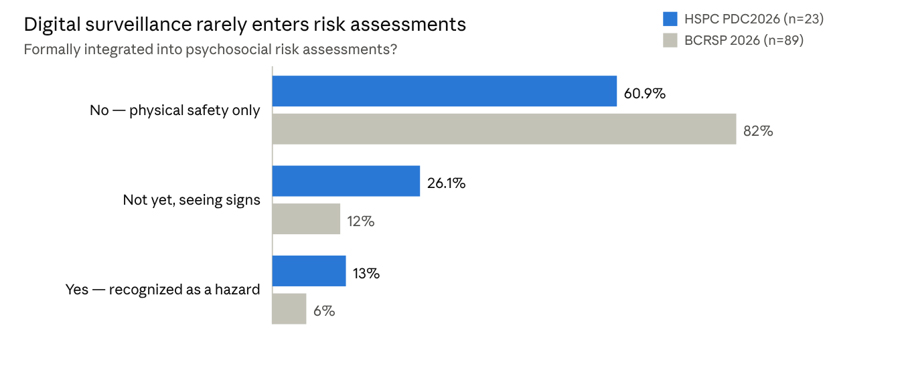
HSPC PDC2026 live poll, n=23 · BCRSP 2026 live poll, n=89
Professionals are expected to use the best available science to categorize risk and identify high-risk cohorts, and the Total Mine Risk framework does so at 70 to 76% accuracy. The contradiction arrives when models can categorize individuals as well as cohorts. Using that capability to screen hiring or firing enters the territory of profiling under Canadian privacy law. Peter described it as firing someone for an accident they have not yet had.
Cheyenne brought in a live legal case. In Mobley v. Workday (N.D. Cal., ongoing in 2026), a federal judge allowed a class action to proceed against Workday, whose AI-powered applicant-screening tools allegedly rejected candidates on the basis of race, age, and disability. One plaintiff claims the algorithm rejected him from more than 100 jobs, and the case tests whether the software vendor, and not only the employer, can be held liable. The structure matches the accident-prone prediction scenario put to the room.
The second debate took up that scenario: if an AI model predicts with 75% accuracy that a candidate is accident-prone, should an organization have the right to deny them employment? Peter argued yes, since hiring someone known to be significantly more likely to be seriously hurt is a duty-of-care violation waiting to happen. Cheyenne argued no, since a prediction is a probability built from other people's accidents and applying it denies someone a livelihood.
In the poll, 54.2% of PDC2026 respondents chose the third option, using the prediction only as a support tool for targeted training after hire. Another 25.0% called it discriminatory profiling and 20.8% would allow it to deny employment. BCRSP's room leaned further toward rejection, at 52% no, 35% support tool, and 13% yes.
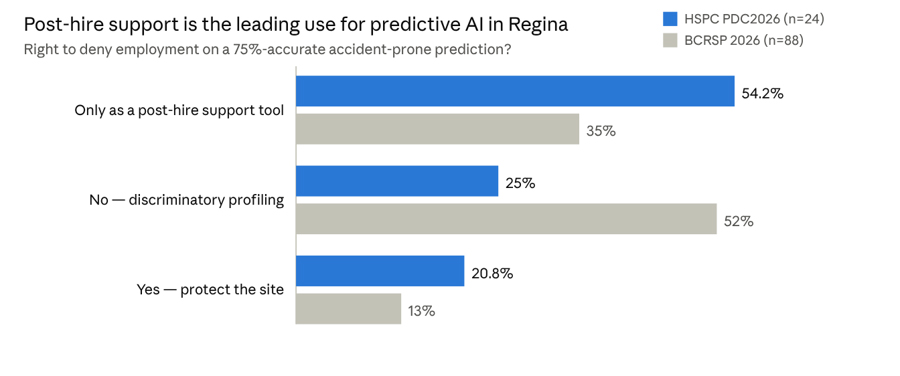
HSPC PDC2026 live poll, n=24 · BCRSP 2026 live poll, n=88
To show how far the logic can run, the speakers laid out a spectrum from benign to ultra-extreme uses of safety data: PPE compliance detected by computer vision, near-miss text mining, wearable GPS for lone workers, serious injury and fatality prediction 48 hours out, socioeconomic mapping from postal code and census data, off-duty social media scraping, benefit-claims linking, and DNA-based screening for hearing-loss susceptibility. The line carries no marked stopping point, and each organization has to decide where its own sits.
The third debate addressed the far end of that spectrum: should company safety systems append external personal data, such as postal code, credit history, and social media activity, to predict individual risk? Peter argued yes. If appending a public data point could prevent one serious injury or fatality, refusing to use it for the sake of comfort is negligence with better manners. Cheyenne argued no. Once safety systems reach into someone's postal code or Instagram feed, they stop managing occupational risk and start building a permanent record of a person's whole life.
This was the point of strongest consensus in BCRSP's May session, where 95% of respondents rejected appending off-duty data such as social media or benefit-provider claims to a safety dashboard, even when framed as preventing a SIF event. The room's reaction showed an appetite for drawing firm lines on purpose.
The final part of the session described how the professional role is changing. Three risks stand out. Bias amplification occurs when a cohort that was always assigned the toughest tasks is learned by a model as inherently unsafe, which turns old inequities into new facts. Granular predictions can present as neutral even though they carry the values and assumptions of whoever designed the model. Appending outside data offers strong predictive power and risks a duty of loyalty that is coerced rather than reciprocal.
The speakers' practical response is a Duty of Loyalty culture. The professional's goal extends beyond hazard reduction to facilitating a transparent dialogue in which employees willingly cooperate with monitoring, in exchange for a robust, data-driven guarantee that the organization will fulfill its duty of care. Peter raised the open question of whether workers are willing when they fear losing their jobs, since loyalty offered under duress amounts to compliance. In BCRSP's room, only 9% said their workforce highly trusts them with health and behavioral data, and 41% said trust is low. A reciprocal arrangement is one way to move that number.
To make the balance workable, Cheyenne introduced the Graphic Equalizer, built on the Five Safes framework: Projects, People, Settings, Data, and Outputs. When the Data slider moves toward biometrics or off-duty behavioral tracking, the People and Settings sliders need to rise with it, through privacy-by-design and genuine organizational trust. Pulling Data back down is one option, and raising the other sliders to match is the more actionable one. External data appended to safety systems amounts to the Data slider at maximum with little else raised to compensate.
The debates and polls often split along a binary line of support or oppose, trust or distrust. In the discussion, three working principles helped the room move past that framing without resolving every open question.
These principles leave the hardest questions open, including whether an AI-flagged risk should affect hiring and how far GPS tracking should extend during travel. They give organizations a way to sequence the conversation: start with uses that keep people in control and in the loop, and treat the more contested uses as a later step.
The two audiences answered most questions in a similar way. The largest differences appear on how organizations measure safety, on surveillance in psychosocial risk assessments, and on the role of predictive AI in hiring.
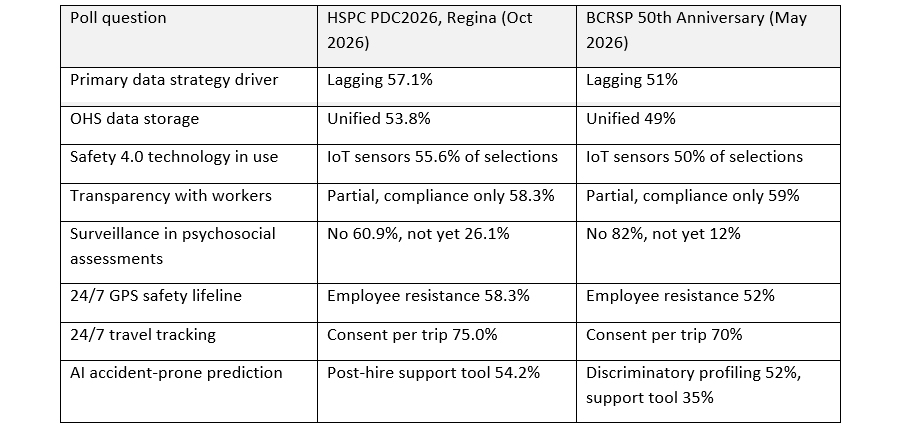
Polling sample sizes were 21 to 27 respondents in Regina and 65 to 121 at BCRSP, so differences of a few points carry little weight. The shifts on psychosocial assessments and on predictive AI are large enough to be worth watching.
Six themes ran through the session. Big data is already here, in retail, insurance, vehicles, and OHS software. The capability gap has closed, and professional judgment is the remaining constraint. Three paradoxes pair a real safety gain with a real human cost: duty of care and privacy, optimization and exploitation, predictive accuracy and discrimination. The professional role is shifting from hazard reducer to ethical arbiter. Trust is the scarcest resource in the conversation. And where an organization draws its line on data is a choice that benefits from being made on purpose.
The session closed on a statement from The Planning Group: the future of OHS is found in achieving Safe Use, technology that serves the worker as well as the metric. The obligation to protect the public interest stays where it was, and the terrain around it keeps moving.
The Planning Group is a management consulting firm, dedicated to helping organizations achieve measurable benefits through the practical application of strategic and operational planning. Since 2002 we have provided business planning consulting expertise, strategic advice, and facilitation to clients in all sectors.
The Planning Group | Management Consulting Firms | Strategy Consulting